The Parking Lot Theory
What a Parking Lot Can Teach Leaders About Customer Behavior
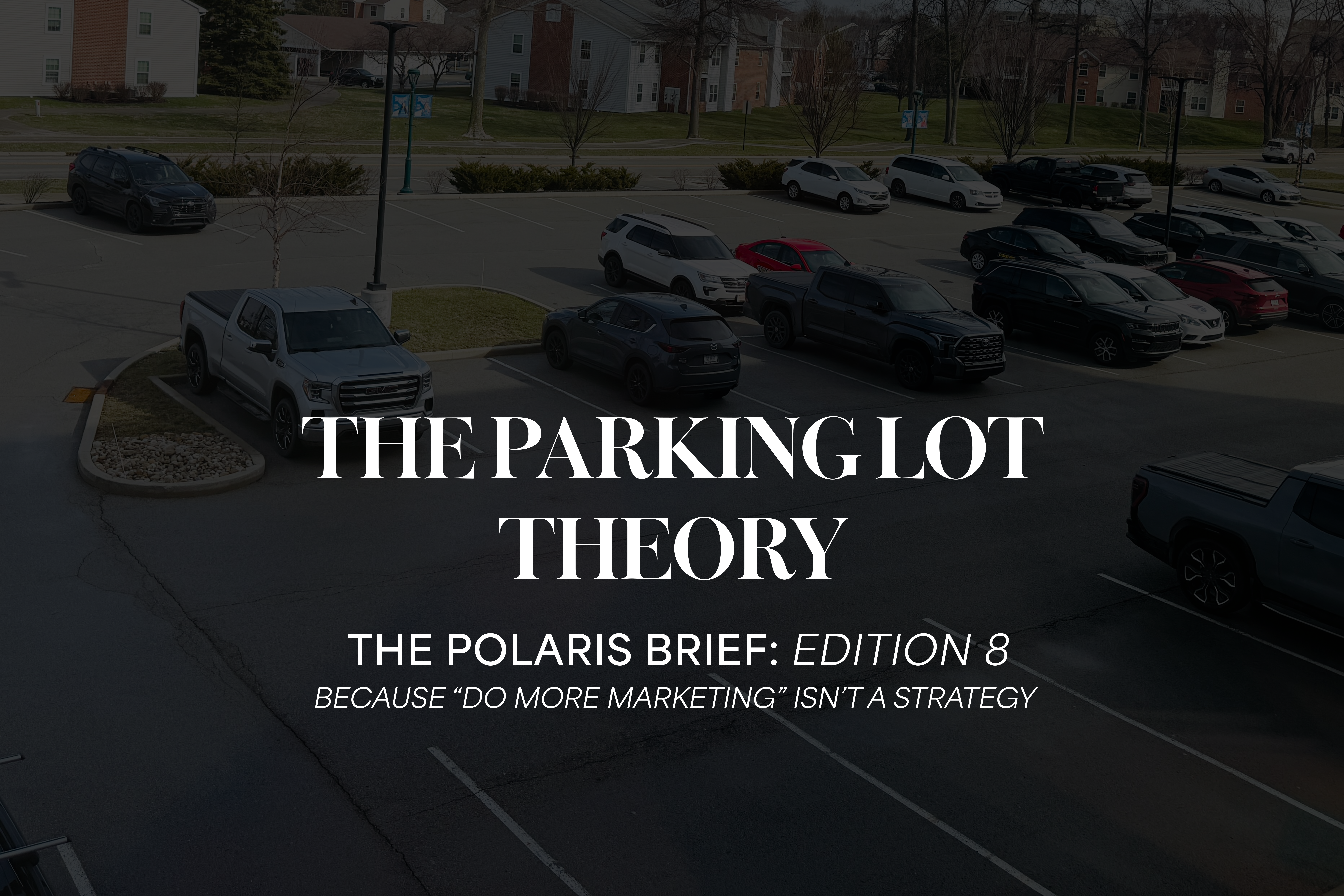
My office window overlooks our building’s parking lot. Not in some dramatic way, just enough that throughout the day I can see people pulling in, circling around, parking, leaving, and doing it all over again. When you watch something like that long enough, patterns start to emerge. People don’t park randomly. They park with intention.
Some people circle the lot waiting for the closest possible spot. Others take the first open space they see and walk. Some park farther away but close to the exit lane so they can leave faster later. Others look for landmarks like a light post, sidewalk, or cart return so they can easily find their car when they come back. What’s interesting is that almost none of them are making a purely rational decision about distance. What they’re really optimizing for is friction.
There’s a simple behavioral principle at play here. People move toward the path that feels easiest, even when it’s not objectively the shortest or most efficient. Call it cognitive ease, call it perceived effort, call it whatever you want. The brain is constantly trying to conserve energy, and when something feels simple, predictable, and low-risk, people gravitate toward it. A parking lot is a perfect example. Someone will spend three minutes circling to avoid walking an extra twenty feet, while another person will park farther away because the path to the door feels clearer and more predictable. Different strategies, same goal. Minimize perceived effort.
The exact same thing shows up in markets every day, and it matters more than most leaders want to admit. Companies often assume customers choose the best option, the strongest service, the most capable team, or the most advanced product. But buyers don’t just evaluate capability. They evaluate effort. They evaluate how hard it is to understand you, how risky it feels to choose you, and how much work it will take on their side to move forward. When that effort feels high, people delay, default, or choose a simpler option, even if it’s not the technically superior one.
This is where marketing either helps or quietly hurts. One company explains its value in a sentence, while another needs a presentation. One website makes it immediately clear who they serve and why it matters, while another requires digging through pages to piece the story together. One brand signals credibility quickly, while another asks the market to trust them without proof. In each case, the buyer is subconsciously asking the same question a driver asks when entering a parking lot: where is the easiest place to land.
Industry leaders spend enormous energy improving capability, and they should, but capability alone doesn’t remove friction. If the market can’t quickly understand your value, quickly trust your credibility, and quickly see how you fit into their problem, your company becomes the equivalent of a parking spot that technically exists but feels harder to reach. People avoid those spots. Not because they’re bad, but because they feel like work.
The companies that consistently gain traction are rarely the ones shouting the loudest about being the best. They’re the ones that reduce friction in how they communicate, how they present themselves, and how they guide the buyer toward a decision. They make it easy to park.
For leaders thinking about this through a practical lens, there are a few places where friction tends to hide. The first is clarity. If someone lands on your website or hears your company name for the first time, they should be able to understand what you do and who it is for within seconds. If the explanation requires interpretation, your customer is already circling the lot. The second is credibility. Humans are wired to look for signals that reduce risk. Recognizable clients, media mentions, testimonials, certifications, and visible expertise all act like the light posts and cart returns in that parking lot. They give people confidence about where they are. The third is decision simplicity. Many companies unknowingly make the buying process feel complicated. Too many options, unclear next steps, or an overly complex explanation can turn a strong offering into a hard place to park.
Leaders who understand behavioral marketing spend as much time removing friction as they do building capability. They simplify their narrative. They reinforce credibility early. They make the next step obvious. When that happens, the market doesn’t have to work to figure you out. The decision becomes easier, faster, and far more natural.
In other words, the companies that grow consistently aren’t always the ones with the best parking spot. They’re the ones that make it obvious where customers should park.